
Understanding hair loss
Male Pattern Baldness: Causes, the Norwood Stages, and What Actually Helps
 Written by Akya Karahan, Junior Digital Content Marketing Specialist
 Medically reviewed by Dr. Muhammet, MD Anatomist and hair transplant specialist
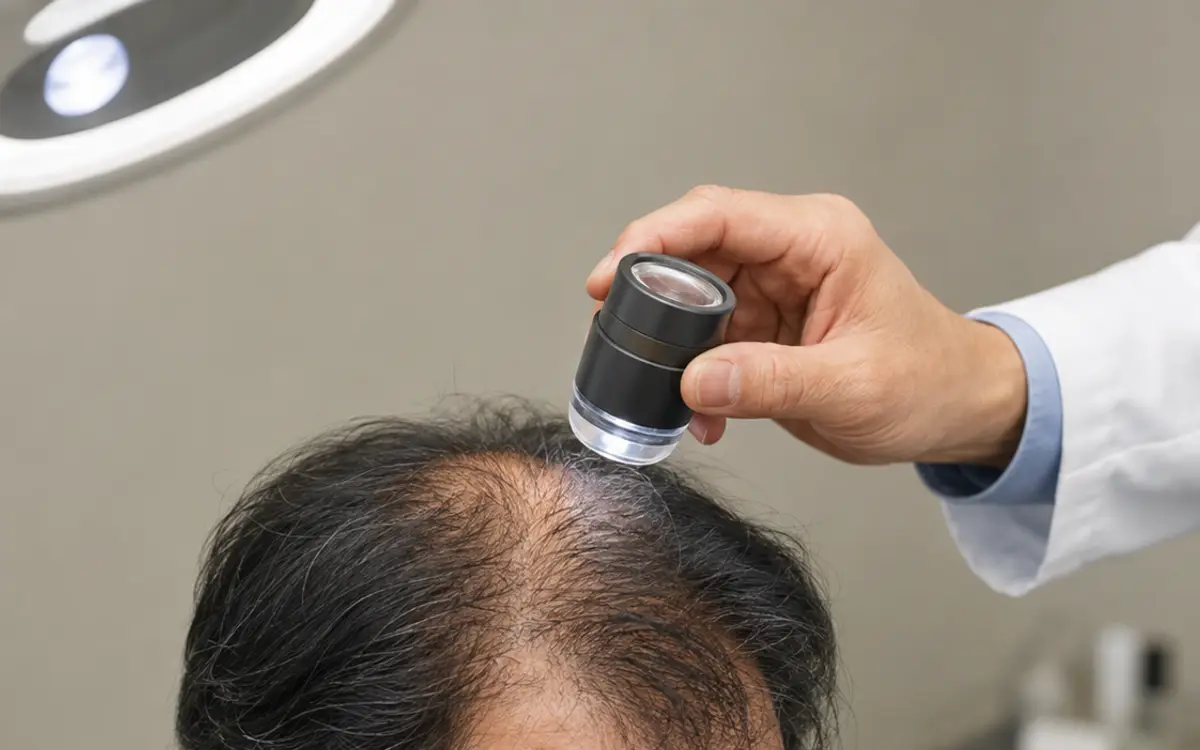
Male pattern baldness is androgenetic alopecia: an inherited sensitivity to DHT that gradually shrinks follicles at the hairline and crown while sparing the back and sides. The Norwood scale grades it from I to VII. Medication can slow early loss; a transplant restores density once the pattern is stable.
What actually causes male pattern baldness
Male pattern baldness, known medically as androgenetic alopecia, is the most common cause of hair loss in men, and it comes down to two things working together: your genes and a hormone. You inherit a sensitivity, from either side of the family, to a hormone called dihydrotestosterone, or DHT. DHT is a by-product of testosterone. In men who are genetically susceptible, DHT gradually binds to receptors on the hair follicles along the front and top of the scalp and, over repeated growth cycles, causes those follicles to shrink.
This shrinking is called miniaturisation. Each cycle, the affected follicle produces a slightly finer, shorter, lighter hair, until eventually it stops producing a visible hair at all. That is why pattern loss creeps rather than falling out in clumps: the hair is not so much dropping as fading. Because the process is driven by inherited receptor sensitivity, it tends to follow the same recognisable map from one man to the next, and often from one generation to the next.
Why the back and sides are spared
Here is the quirk that makes the whole condition treatable. The follicles at the back and sides of your head, the horseshoe band above the ears and across the lower crown, are largely DHT-resistant. They carry different genetic programming and keep growing normal, full-calibre hair for life, even while the top thins.
This is the single most important fact behind a hair transplant. Surgery does not create new hair or “cure” the underlying tendency. It relocates your own permanent, DHT-resistant follicles from the donor band into the thinning zones, where they keep their original resistance and carry on growing. It is a redistribution of the hair you were always going to keep. It also explains why the donor area is finite and why timing and planning matter: a surgeon is working with a fixed supply of resistant follicles that has to be spent wisely.
The Norwood scale, stage by stage
Doctors describe how far pattern loss has progressed using the Norwood scale, which runs from stage I to stage VII. In plain terms:
- Stage I: a full, juvenile hairline with no real recession.
- Stage II: slight recession at the temples, the normal maturing seen in most adult men. If you are unsure whether your own line is simply settling, our guide to a mature hairline versus a receding hairline walks through the tells.
- Stage III: the first clearly balding stage, with deeper temple recession forming an M shape. Stage III vertex adds thinning at the crown.
- Stage IV: more pronounced frontal loss and an enlarging bald patch at the crown, with a band of hair still separating the two.
- Stage V: that dividing band narrows and weakens as the two areas move towards each other.
- Stage VI: the bridge is largely gone and the front and crown merge into one balding region.
- Stage VII: the most advanced pattern, leaving only the horseshoe of hair at the back and sides.
Most men do not sail smoothly to stage VII; loss often slows or settles at a particular stage. Knowing roughly where you sit, and whether you are still moving, matters more than pinning down the exact number.
Not sure which stage you are? Our free graft calculator lets you match your own hair to these stages in about a minute, then gives you an honest graft-count estimate and the technique that tends to suit it. It runs entirely on your device, so there is no photo to upload and nothing leaves your browser.
What actually helps at each stage
The honest answer is that the right approach depends on how much hair you still have and, crucially, whether loss is active or stable.
In the earlier stages, when follicles are miniaturising but still alive, medication is the mainstay. Minoxidil, applied to the scalp, prolongs the growth phase and can thicken existing hair; you can read more in our overview of whether minoxidil actually works. Finasteride, a daily tablet, lowers DHT levels and can slow or partly halt progression. Both work only while you take them, both have possible side effects worth discussing with a doctor, and neither is a permanent fix: the gains reverse if you stop. Medication maintains and defends; it does not regrow a fully bald scalp.
A transplant addresses a different problem: restoring density to areas where the follicles are already gone. It is generally considered once loss has settled into a clear, stable pattern and there is a healthy donor area to draw from. The two main methods, FUE and the DHI technique, both move individual follicular units from the donor band to the thinning zones. Many men do both things at once: a transplant to rebuild the areas that have been lost, plus ongoing medication to protect the native hair that remains, so the result does not turn patchy as untreated hair keeps thinning around it. Looking through real before-and-after results is a sensible way to calibrate what is realistic for a given stage.
Assess early, while your options are widest
The pattern is easiest to manage before it is advanced. Early on there is more native hair to protect, medication has more to work with, and any future surgical plan has a fuller donor area to draw from. That is not a reason to panic-book an operation; it is a reason to find out where you actually stand.
According to the NHS, most hair loss is not caused by anything you have done and does not necessarily need treatment, though it can be distressing. Their overview, Hair loss, is a solid independent starting point.
If you would like a clear read on your own stage, you can send a few photos for a free, no-obligation assessment and request a candidacy check. There is no pressure to book anything, and being told you are stable and simply need to monitor is a perfectly good outcome.
Medical disclaimer. This article is general information, not individual medical advice, diagnosis or a treatment recommendation. Hair restoration is surgery and outcomes differ from person to person. Always seek an individual assessment from a qualified medical professional before deciding on treatment.