Planning your treatment
Beard Transplant: Cost, Procedure and Results
 Written by Akya Karahan, Junior Digital Content Marketing Specialist
 Medically reviewed by Dr. Muhammet, MD Anatomist and hair transplant specialist
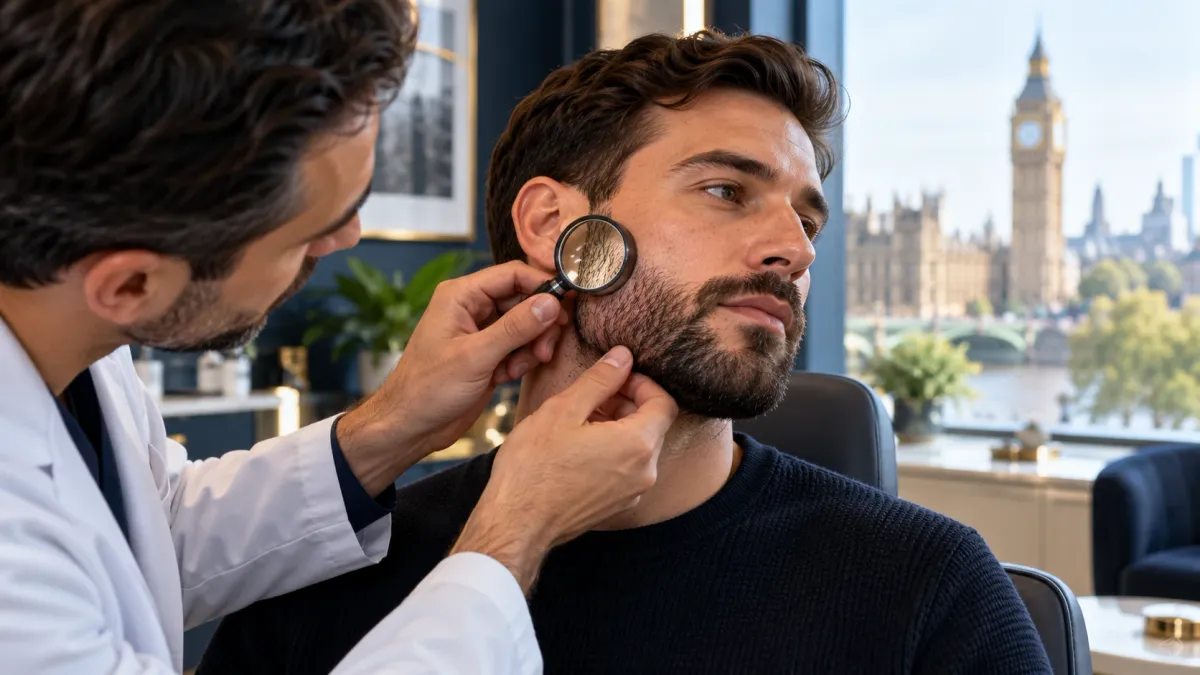
A beard transplant moves hair follicles from your scalp donor area to the face using FUE or DHI, filling patchy beards, scars and bald spots. Cost depends mainly on the graft count, usually around 1,000 to 3,000 grafts. New growth starts at three to four months, with final density by nine to twelve months.
If your beard grows in patchy, thins at the cheeks or never quite filled in the way you hoped, a beard transplant can give you a fuller, even line that you shave, trim and grow like natural facial hair. It is a permanent procedure, so it pays to understand who it suits, how it is done and what actually drives the price before you commit. This guide walks you through the whole decision in plain English, with no pressure and no guarantees we cannot stand behind.
Are you a good candidate for a beard transplant?
The best candidates have patchy or uneven facial hair, a cheek line that will not connect, or a defined gap they want filled. It also works well over scar tissue, such as old acne scarring, cleft repair scars or burns, and for thinning linked to conditions like alopecia where the pattern is stable.
Two things matter most. First, you need a healthy donor area on the back and sides of your scalp, because that is where the grafts come from. Second, your situation needs to be settled, not actively changing. If your facial hair loss is ongoing or you are very young and the pattern is still developing, a surgeon may advise you to wait.
A realistic assessment is honest about limits. No ethical clinic can promise a specific density or a particular look from a photo alone. The right first step is a proper consultation, which you can start with a free quote and assessment, where a clinician reviews your donor supply and your goals before anyone talks numbers.
How a beard transplant works
A beard transplant uses the same follicle-by-follicle technique as scalp surgery. Individual hair follicles are harvested from your scalp donor area, then placed one at a time into the face at the angle and direction natural beard hair grows.
Most beard work is done with FUE (follicular unit extraction), which removes grafts individually and leaves only tiny, scattered marks rather than a linear scar. Many clinics use DHI (direct hair implantation) for the face, because the implanter pen gives fine control over the angle and depth of each graft, which matters enormously on cheeks and jawlines where every hair is visible.
The International Society of Hair Restoration Surgery notes that fine one and two hair grafts are what create a natural front line, which is exactly the principle a good beard design relies on. Source: ISHRS (in English).
Beard design and looking natural
Design is where a beard transplant is won or lost. A natural result is not simply about adding hair, it is about where the hair goes and which way it points.
A skilled surgeon maps your cheek lines, moustache, neckline and the transition to your sideburns so the new growth suits the shape of your face. Density is graded rather than uniform, so the beard looks slightly lighter at the edges and fuller through the body, the way facial hair naturally behaves. Single-hair follicles go along the outer lines for softness, and the angle of every graft follows the downward and outward flow of real beard hair.
This is the part that no price list captures and no two faces share. It is worth asking any clinic how they plan the design and whether you approve the line before surgery begins.
What a beard transplant costs
The honest answer is that the price is built from your graft count, not pulled from a menu. Cost equals the number of grafts multiplied by a per-graft rate, so two people rarely pay the same amount.
A beard typically needs somewhere around 1,000 to 3,000 grafts depending on how much of the face you are filling. Full cheeks and a connected jawline sit at the higher end, while a defined gap or a thin moustache needs far fewer. That graft range, not a single headline figure, is what moves your total up or down.
The NHS does not fund beard transplants, as it is a cosmetic procedure, so any treatment is private either in the UK or abroad. Source: NHS (in English). Prices differ widely between the UK and Turkey, and we will not publish an invented figure here. Instead, estimate your likely graft count with our hair transplant graft calculator, then get your exact, no-obligation price through a free quote. You can see the full approach to facial work on our beard transplant in Turkey page.
Results timeline and permanence
Patience is part of the plan. In the first two to three weeks the transplanted hairs shed, which is completely normal and does not mean the grafts have failed. Cleveland Clinic explains that transplanted hair can fall out as it heals and then grows back, and that it can take up to a year to see the full result. Source: Cleveland Clinic (in English).
New growth usually appears from three to four months, thickens through months six to nine, and reaches its final density around nine to twelve months. Once established, the transplanted hair is permanent and behaves like the rest of your beard, so you can shave it, trim it and let it grow.
Aftercare in the first days protects your result, and avoiding a few common slip-ups makes a real difference. Our guides on the recovery timeline, how long a transplant lasts and the mistakes to avoid afterwards cover what to expect week by week.
How to choose a clinic safely
Because the results are permanent, the clinic you pick matters more than the price you pay. Check that a qualified surgeon leads your procedure and plans the design, not just a technician. Ask how many grafts are planned and why, confirm the technique, and make sure you approve the beard line before anyone starts.
The NHS advises checking a practitioner’s credentials carefully before any cosmetic procedure, and the ISHRS lets you confirm whether a doctor is a recognised member. Treat anyone promising a guaranteed density or a flawless result with caution, because an honest clinic talks in realistic ranges, not promises.
When you are ready, map your likely grafts with the graft calculator and request your personal assessment through a free quote. It costs nothing to find out whether a beard transplant is right for you.
Medical disclaimer. This article is general information, not individual medical advice, diagnosis or a treatment recommendation. Hair restoration is surgery and outcomes differ from person to person. Always seek an individual assessment from a qualified medical professional before deciding on treatment.