Understanding hair loss
Norwood 7 hair transplant: what's actually possible, and what results can you expect?
 Written by Akya Karahan, Junior Digital Content Marketing Specialist
 Medically reviewed by Dr. Muhammet, MD Anatomist and hair transplant specialist
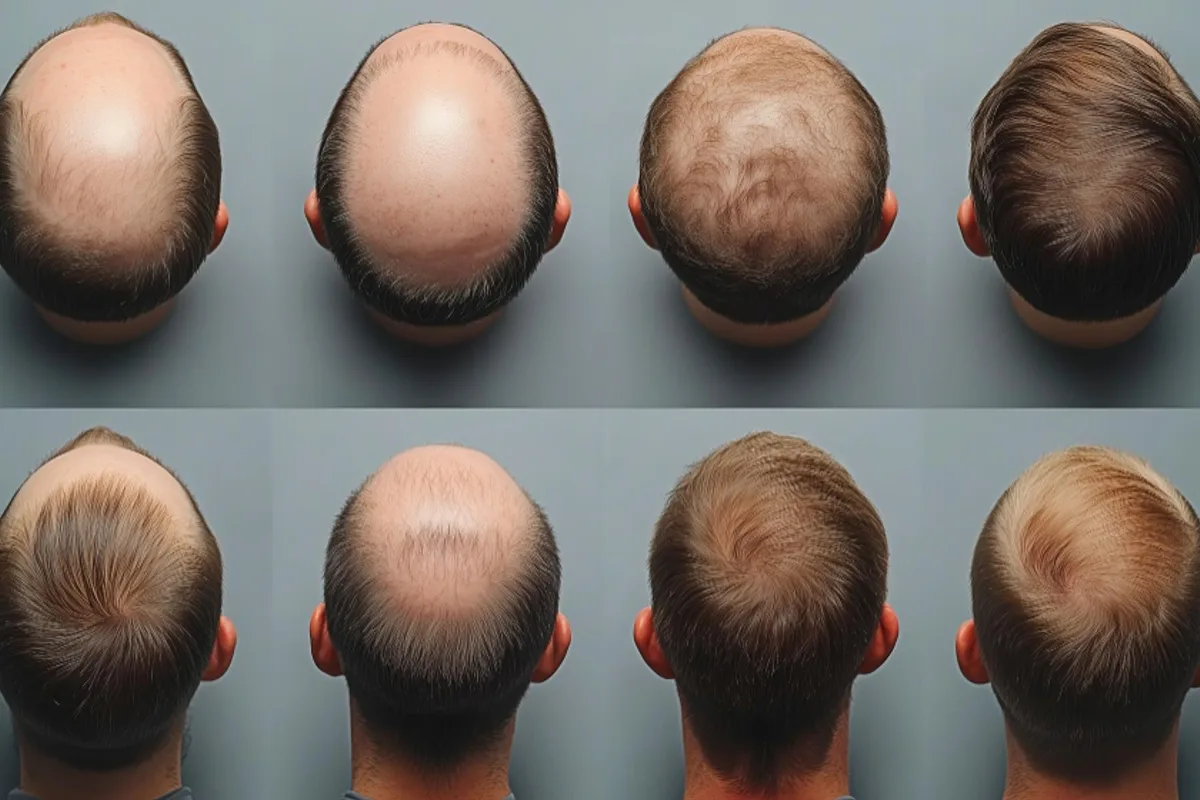
Norwood 7 is the most advanced stage of male pattern baldness, with hair remaining only in a horseshoe band at the back and sides and none at all on the crown or mid-scalp. A hair transplant is still possible, but donor supply is the real constraint: a Norwood 7 patient has a thinner, finite donor area, so results usually prioritise the frontal third and a believable overall framework rather than full density everywhere, often across two or more sessions, sometimes combined with body hair grafts or scalp micropigmentation where graft count alone cannot deliver density.
What Norwood 7 actually means
The Norwood scale is the standard way doctors classify male pattern baldness, running from stage 1, no visible loss, to stage 7, the most advanced. At Norwood 7, hair remains only in a narrow band running from ear to ear around the back of the head, with the frontal hairline, the mid-scalp and the crown completely bald and no bridge of hair connecting the two sides across the top. It is the stage most people picture when they think of "going fully bald," and it is also the stage where a hair transplant becomes genuinely more complicated, rather than impossible.
Is a hair transplant possible at Norwood 7?
Yes, a hair transplant is possible at Norwood 7, and clinics perform them regularly, but the honest answer is more nuanced than at earlier stages. The surgery itself, extracting grafts and implanting them, works the same way regardless of how advanced the baldness is. What changes is the maths: at Norwood 7 the bald area to cover is large, and the donor area supplying grafts is smaller and thinner than it would be at Norwood 3 or 4, because male pattern baldness often continues to thin the donor fringe itself over time, even in the band that technically "holds."
Because of that mismatch, the realistic goal at Norwood 7 usually is not full, uniform density across the entire scalp. A good surgeon will talk candidly about prioritising the areas that matter most for how a hairstyle reads, generally the frontal third and hairline, over chasing density on the crown, where even a large number of grafts spread thinly will look sparse.
How many grafts does a Norwood 7 transplant actually need?
- Total donor supply. A typical donor band at Norwood 7 can realistically supply somewhere in the region of 6,000 to 9,000 grafts over a lifetime, though this varies significantly by hair density, scalp laxity, and how much the donor area itself has thinned.
- Single session vs staged. Most Norwood 7 cases are planned across two sessions, sometimes three, spaced roughly 8 to 12 months apart, rather than one very long single procedure, both for safety and because seeing how the first session settles helps plan the second more precisely.
- Typical first-session range. A first session commonly moves 3,000 to 4,500 grafts, concentrated on the frontal hairline and the front half of the scalp, where visual impact per graft used is highest.
- Crown coverage is often deprioritised or partial. Because the crown has a natural whorl pattern that needs higher density to look convincing, and is one of the least visible areas to the person themselves in a mirror, many surgeons recommend leaving it thinner or untreated in favour of the frontal two-thirds.
The techniques used for advanced baldness
- FUE (Follicular Unit Extraction). The standard technique for advanced cases, extracting individual follicles so the limited donor supply can be used as efficiently as possible, without the single long scar of older strip methods.
- DHI for the hairline. Used to place the frontal hairline with precise angle and direction, which matters more at Norwood 7 because the hairline is doing more visual work with less density behind it.
- Body hair transplantation (BHT). Hair from the beard, chest or body can supplement a limited scalp donor area once it runs low, though body hair differs in texture and growth cycle from scalp hair, so it is usually blended in rather than used for the hairline itself.
- Scalp micropigmentation (SMP), as an addition rather than a replacement. Tattooed pigment that mimics the look of a closely shaved scalp, often combined with a transplant to create the appearance of density on the crown or in areas where graft count alone would look thin.
What results actually look like, realistically
Honest before-and-after photos from Norwood 7 cases generally show a believable, styled frontal third and upper scalp, with hair that reads as a deliberate short or cropped style rather than a full head of thick hair. Crown coverage, if attempted, is usually described by patients and surgeons alike as "improved" rather than "restored."
Results from a Norwood 7 transplant take the same 10-to-14-month full-growth timeline as any transplant, but because multiple sessions are common, the complete picture, including a second session, can take two years or more to fully assess.
Why donor hair is the real limiting factor
Donor hair does not regenerate once it is used, so every Norwood 7 plan is really a budgeting exercise: deciding where the available grafts will do the most visible good, because there usually is not enough donor supply to treat the entire bald area at a density that would look fully natural everywhere at once. That is also why a clinic that promises full density across the whole scalp at Norwood 7 without qualifying it is worth being cautious of, the limitation is physical, not a matter of paying for more grafts.
Whatever stage you're starting from, an honest plan beats an ambitious one: knowing what your donor area can and cannot support before you book anything is what actually determines whether you will be happy with the result. If you want a straight answer on what is realistic for your own case, send a few photographs and request a free assessment.
See our full guide to hair transplants in Turkey for more on how the procedure works from consultation to recovery. →
Find out whether you are a candidate
Send us photographs and we will give you an honest assessment, including whether surgery is the right option for you.
Medical disclaimer. This article is general information, not individual medical advice, diagnosis or a treatment recommendation. Hair restoration is surgery and outcomes differ from person to person. Always seek an individual assessment from a qualified medical professional before deciding on treatment.